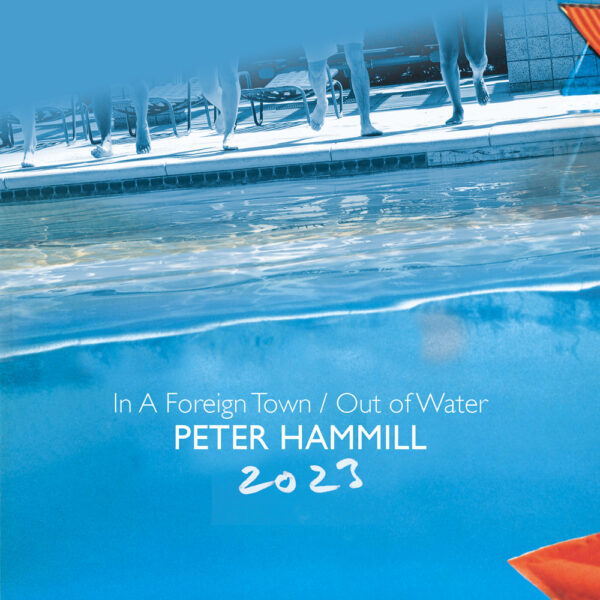
Originally recorded in the late 1980s, these solo albums by Van Der Graaf Generator frontman Peter Hammill reveal much about the changing face of the music industry back then, while these new recordings have us questioning if music itself is truly timeless, and if not cannot be repurposed for listeners in the present tense.
There was a period during that decade where I invested heavily in Hammill’s work, coming late to the party I bought as many records on vinyl by him that I could. His was often a voice that spoke to me, expressing words I felt but could not fathom how to utter aloud. I recall those purchases being at the Virgin Megastore, the shop’s third location in Birmingham, having first established itself as a headshop just down from the law courts in the ‘70s. Virgin not only sold Hammill’s recorded output but a fanzine dedicated to his work entitled Pilgrims – I bought several copies, and a cursory perusal of the internet shows some are quite valuable now, compared to what I would have paid for them. These were heady days indeed as music was now more than ever big business. Well, for some.
I wondered why I hadn’t picked In A Foreign Town or Out Of Water up at the time. Casting my gaze round the internet once more, it appears As Close As This, from two years previous became my last Hammill-related purchase for quite some time. I can’t recall my fortunes, taste in music, or similar changing drastically during that period. And certainly, his work in the ‘80s appealed to more than that from the ‘70s.
Distribution may well have been the reason. Originally signed with Charisma, his more recent records with Virgin, for In A Foreign Town and two albums thereafter came out on Enigma Records. A once vibrant British music press was refashioning itself from weekly newsprint editions to glossier monthly models, with its news now built around the press releases of those who sold out arenas, not theatres. This meant if there were no new records readily available in store, I was likely unaware of their existence. It would take an evolving cottage industry for that to change, alongside the advent of the internet. Thus, during this period access to records one might want was becoming a problem, as the industry herded you towards buying the same records as everyone else.
Technology had advanced dramatically too. At one end of the spectrum, millions were being poured into recording studios, even for those who but a few years previous had created the New Romantics and new wave scenes, following the advent of cheaper keyboards. Fortunately, home studios were now also proving cost effective, if your ambitions weren’t over ambitious. Again, the years following all this would change again, for good and bad, perhaps. As with Peter Gabriel, and not too far away distance wise, Hammill had set up his own studio, and his previous album had made much use of a MIDI programming keyboard to orientate sounds played on piano and the like. It transpires he went several steps further next time round. Reaction by his listening public, however, was apparently indifferent.
In his sleeve notes for this collection, Hammill expresses the production for those records was necessary for his continuing evolvement as an artist, and no doubt for making music to continue to be a career choice. That the rights to those records previously issued by Enigma Records is now a legal loophole, so Hammill instigated a way for them to become once more part of his available back catalogue and in doing, diminish aspects of the recordings he and critics found wanting. With further advances in technology, his own advanced knowledge and experience with such and by the very act of going to the source recordings where possible, or recreating parts, we now have this new collection, In A Foreign Town/Out Of Water (2023) to experience.
For those with access to the original recordings, they will be able to compare them. For me, save for a track or two heard elsewhere, the works are wholly new.
Save for Stuart Gordon playing violin on the opening track, all other instrumentation on 1988’s In a Foreign Town was performed by Hammill and so too on the 2023 version. Perhaps it’s due to the changes made, for I find little here musically that Hammill’s fans would find much out of place in his other works. What’s apparent throughout though, is its shift in lyrical focus – Whereas deep and heavy browbeating considerations of existential personal concern, mulling over death, and mortal interaction on an intellectual level had been the previous diets we had fed upon as listeners, now the focus was much more outward, looking at, discussing, and pointing direct fingers at the follies and greed humankind increasingly succumbed to. This statement of intent writ large in ‘Hemlock’.
Rumbling into a haunted Asiatic half-life, a bass looping in casual dancing motion, guitars tear out brittle phrases and like some anthem to a coming apocalypse Hammill runs through a list of those political lies, half-truths and propaganda being fed the world populace back then, with only the names of the guilty slightly rewritten during the intervening decades, thus still unfortunately deadly relevant. Musically it moves like an upbeat rendition of A Black Box’s ‘Fogwalking’ without the Goth element and the statelier aspects of The Future Now’s ‘Thirty Something’. The precise dictation of his words spat out with disgust one might initially be put off, but the slow winding melody is not a dirge, instead drawing you in slowly, the words becoming ever more alive in their intent.
‘Invisible Ink’ continues to detail mistrust decades before Trump jumped on the bandwagon with his fake news diatribe, here musically it saunters with a sultry soul dance groove, its backing vocals while warm echoing the torment Bowie affected on Diamond Dogs, and a dog whining guitar lick of the kind Fripp might choose to affect. ‘Sci-Finance (Revisited)’ can be pretty much taken as read by its title regarding its theme, but if you’re expecting the same doom and distortion of the version found years previous on Vital: Van der Graaf Live, this is a much smoother number, dare we say sixties beat-pop friendly even. ‘This Book’ follows in a similar manner, while echoing some of those psychedelic qualities found in his early records, contemplatively it is a turning point, wherein the singer begins to look beyond what is and possibilities inherent in the future, and as such there is a romantic feel to it all that enhances that. The intimacy intensifies, with ‘Time To Burn’, an instrumental version concluding the record, the version sung being reflections on Charisma label and manager Tony Stratton Smith’s passing. In both, tender glockenspiel sounds tinkle gently and synthesisers wrap you warmly, in all a work of melancholic beauty.
Germanic by way of its lyrical allusions and Euro disco sound, in an alternative universe ‘Auto’ is the unlikely offspring of Kraftwerk and Fashion and if given a 12” vinyl remix would no doubt have filled the dance clubs of Berlin back in the day. Wrapped in textures of slow dancing jazz ‘Vote Brand X’ brings the world view of ‘Hemlock’ down to an objective personal level, while ‘Sun City Nightlife’ returns us to nightclub land in a drug-fused miasma warning the white playboy’s days may not be long for this world.
‘The Play’s The Thing’, using lines from Shakespeare’s Henry IV Part 2, returns us to what we might consider Hammill’s overall central theme as an individual – Even though we acknowledge this great folly we call our individual lives still we carry on. His received pronunciation is here presented at its finest, piano takes the part of central accompaniment, assorted synths presumably appropriating classical instruments as haunting embroidery. The song stops you in your tracks, surrounded as it is by more rhythmic material, not least Northern soul dancing on the edge of the apocalypse in ‘Under Cover Names’ and the off-kilter reggae undertones of ‘Smile’, the album fading into memory grooves with the instrumental ‘Time To Burn’.
I’ve quickly grown fond of this album. How different it was in its original form maybe one day I’ll discover. The songs themselves are not overlong, and the way the musical styles of the songs blend or contrast with each one is a rewarding treat for those of us who still believe a long playing album is best appreciated played in order.
The original version of Out Of Water appeared in 1990. It features the return guitarist John Ellis and Nic Potter from Hammill’s K group, the latter having been an on-off member of Van Der Graaf too and multi-saxophonist David Jackson of that lineage is also present, and Stuart Gordon on violin. Albeit these musicians appear only on certain tracks, it definitely comes across as more of a group effort in the songs accomplished deliveries, and they themselves are longer so fewer.
Out Of Water was a slight change in direction, featuring a more band orientated approach with contributions and featuring a more confident approach from Peter with regards to mastering the studio technology of the day. Eerily oddball and progressive ‘Evidently Goldfish’ applies that old belief that a goldfish’s memory is slight, and accepting of each new experience met as it tours its bowl, to our own blind acceptance of the powers that be. ‘Not The Man’ relates a potential breakthrough from such Kafkaesque states of mind over ribald folk rocking partnered in equal supporting roles by parts that might call themselves pop, church-like and soulfully progressive.
Amid changing soundscapes ‘No Moon In The Water’ appears to take the death themes expressed in 1985 album Skin’s ‘Four Pails’ questioning that number’s one-sided view, but ultimately leaving the matter unresolved. ‘Our Oyster’ concerns itself with the Chinese state’s massacre of its own students at Tiananmen Square in 1989. Pretty but sad melodies play, the potent words are the thing. Another song that remains far too poignant today, and hopefully its mannered potency felt by those who hear it.
Gordon’s gypsy violin and the acoustic guitar on ‘Something About Ysabel’s Dance’ serenade memories of times gone by. Thematically, it appears a more sympathetic decades later continuation to 1977 album Over’s bitter ‘(On Tuesdays She Use To Do) Yoga’, though it’s no doubt not. Musically, the sleeve notes tell us how Hammil has added the instrumental section they performed live, taking Charles Mingus’s ‘Ysabel’s Table dance’ as a reference point.
Moody rocker ‘Green Fingers’ is an early Martin Amis novel reduced to its most pertinent points, mulling somewhere between The Cure and Marillion. ‘On The Surface’ is the theme from Jaws tilted askew, shanty wailing and ominous noises besides, more an experience than a song to these ears, though the much underrated Ellis’s extended guitar on the playout is worth the admission price alone. Thus, we are left with ‘A Way Out’ to wave us goodbye with pedigree Hammill material. Ballad, classical in tone despite its instrumentation, his voice at turns senatorial, confused, apologetic as its brings aspects touched on both these albums into a questionable conclusion, with love at its heart. Again, some very nice guitar heard on this, and in a completely different style.
Of these two albums, the shorter immediacy of the In A Foreign Town tracks hooked me back in as a Peter Hammill addict. But both are valid, often remarkable, records in these current renditions. Oh, and all such should come with lyric sheets as this collection does.
Track List:
Disc 1 – In a Foreign Town (2023)
Hemlock
Invisible Ink
Sci-Finance (Revisited)
This Book
Time To Burn
Auto
Vote Brand X
Sun City Nightlife
The Play’s the Thing
Under Cover Names
Smile
Time To Burn (instrumental)
Disc 2 – Out of Water (2023)
Evidently Goldfish
Not The Man
No Moon In The Water
Our Oyster
Something About Ysabel’s Dance
Green Fingers
On The Surface
A Way Out