
As Bloodstock Open Air draws ever closer, Paul Castles catches up with band booker Vicky Hungerford, to learn more about the trials and tribulations of running one of the UK’s longest-running and most successful outdoor metal festivals.
 MR: To what extent has Bloodstock been affected by things such as the Cost of Living crisis, Vicky? Has it become harder to sell tickets over the last few years?
Obviously, the pandemic was a huge thing, it put a lot of people out of work and had a big impact on the economy as a whole. We are well aware everything keeps going up, including for festival organisers like us. We have seen a change in buying patterns. We do a deposit scheme to help people pay more easily and we’ve had huge influx with more people using that. We’ve also worked hard to keep Early Bird tickets at a low price. We never take things for granted and we are very appreciative of our fanbase. We know a lot of them use their savings to come to Bloodstock and we don’t take that for granted. For some people it is their only holiday they have all year.
MR: Bloodstock started modestly as an indoor event in Derby. Did you ever expect it to grow in the way it has?
No! We never thought that. It started as indoor event for 700 people. We had no experience of running a music festival. My dad just said there’s no Monsters of Rock so why don’t we do something, how difficult can it be! If you told us then that 22 years later, we’d have 20,000 people coming to Bloodstock every year we’d have never dreamed that.
MR: Not all festivals have been as successful as Bloodstock. Quite a few have come and gone over the years, why is that?
I think some people don’t understand what goes into running a big event like a festival. Some smaller festivals have come to us for advice and we’re always happy to help people. We’re not festival gurus but we have some experience. But the market place is now more crowded. When Bloodstock started there wasn’t a Download Festival at that time. Monsters of Rock had gone, there was no Arctangent or Damnation back then. At the start we didn’t even have social media to spread the word so there was a lot of hard work. It breaks my heart when i see a festival struggle and go under. I like to think with Bloodstock fans look at the longevity of the event and that’s reassuring for fans when paying up front for tickets. But it’s not an easy market.
MR: Are the big European festivals like Hellfest and Wacken rivals?
No, not at all. Of course there are festivals all over Europe now too. There is a collective body called the UFF (United Festival Force) who we are part of it with six other European festivals like Summer Breeze and Brutal Assault, who also stage their events in the summer. We’re all friends operating in different territories, so they don’t really crossover. It’s a positive as it means the UFF can approach bigger bands offering them slots at several European festivals within a week or two. So that has more appeal say for a band from the United States, who may not have the time or money to fly over just to play one festival. They can come and play two or three which makes it much more worthwhile for them. I also have a great relationship with Andy Copping at Download who has been a huge source of advice and inspiration down the years.

MR: You open up to fans regularly with your social media chats. How important are they in maintaining Bloodstock’s profile throughout the year?
They are very important. I don’t want anyone to see Bloodstock as a ‘them or us’. This festival is still run by my father and his kids. It is not a big corporate affair. Some people think that it is and that upsets me massively. The event has grown but our ethos hasn’t changed, we’re just more experienced. If someone offered us a lot of money to buy the festival, then it wouldn’t be Bloodstock anymore. If you want an event with 50,000 fans you’ve got Download. Bloodstock is more intimate, we don’t want to be Download-lite competing for the same bands. We’ll have bands who you would otherwise never get to see over here and we give them main stage and Sophie Stage slots.
MR: You often see bands progress over the years from the New Blood Stage to the Sophie, and the Sophie to the main stage – how satisfying is that?
It’s fantastic to see bands progress. Gojira first played the Sophie Stage, then went to mid-level main stage before headlining the main stage. To see that progression with a band over a number of years is incredible.
MR: Have there been many bands who you’ve had a hard time with down the years?
Not many, but it does occur, and there have been occasions when I have thought that band won’t be coming back. But I look at it from a fans’ point of view, not just mine – but it is very rare on the whole.
MR: Last year Megadeth did a small private event for which fans were charged extra – were you ok with that?
Yes, that kind of thing is quite common, other festivals do it. These ‘meet and greets’ are part of the Megadeth package. Some people think they’re expensive but they’re actually not against what some other artists charge. For fans who want that more intimate experience with an acoustic set and the band answering a few questions they can work really well.
MR: Last year you were dealt a headache with the late withdrawal of Helloween. How do you manage those situations?
Things like last minute band withdrawals and really bad weather are our worst nightmares. When the news came in about Helloween I went cold but when a singer has got laryngitis there is very little you can do. People ask if we have a contingency band and usually we don’t. All you can do is see who’s around in Europe and if they could possibly get here with such short notice.
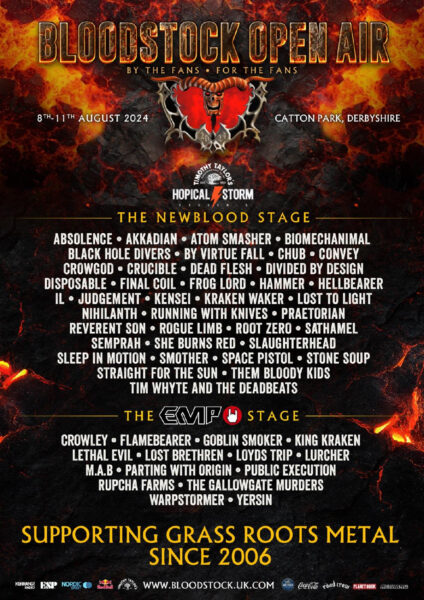
MR: How pleased have you been to see the way in which the Metal 2 The Masses competition has evolved?
It’s been incredible, it’s all over the UK and beyond, we never expected it to grow like this. The original idea was my dad’s as a way to support and encourage young bands. When Simon Hall joined our team in about 2007 he had lots of ideas how it could be done, and my dad asked him to run it.
Simon is the heart and soul with M2TM and goes to most of them himself. He is hugely respected through the metal community and as a festival we’re very proud of what M2TM has achieved. The regional events are hugely attended and it really helps promote new young unsigned bands. Venues like it as it pulls people through the door, at a time when many venues have struggled since the pandemic.
MR: How much thought do you put into attracting the right stallholders to Bloodstock?
A lot… most of our traders want to come back year on year, but we’re trying to expand and increase our metal market and make that area even bigger. I’ve seen some great ones across Europe, and for us it is all about evolving. Brexit hasn’t helped and some companies can’t afford to travel to festivals although we haven’t seen too many who have ceased coming.
MR: How much of your life is now taken over by Bloodstock?
It’s every week, it really is all-consuming. I am constantly liaising with bands and PR agencies not just for the current year and the one after but sometimes the one after that too! I spend a lot of time networking at gigs and events. We never take anything for granted and are always looking to better the festival and improve the fans’ experience.
MR: Are you able to actually enjoy the festival yourself?
Well I usually miss a lot of bands as I’m sorting problems or whatever. I don’t get to see half the bands I’d like to, but the headaches usually come earlier in the day. So I normally catch the headliners. Bands often fly in on the day they’re playing so travel problems can happen. Last year Sacred Reich came by ferry which was over two hours late so there’s always something to keep me busy.
- For all the very latest Bloodstock ticket and travel news click here.
- Bloodstock on Facebook


