
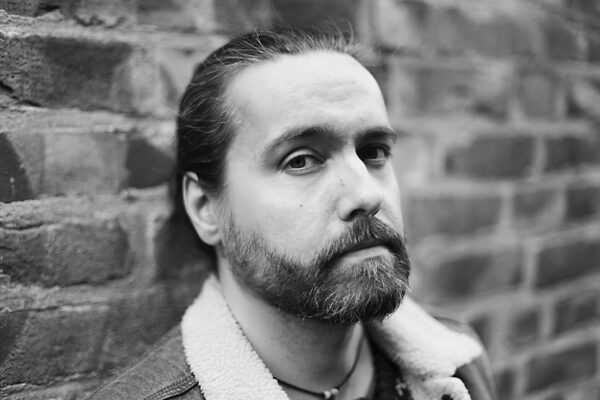
 Hailing from Trondheim, Norway, holon is the brainchild of multi-instrumentalist Ronny Pedersen. Using progressive rock as a canvas, Ronny creates a cinematic sound that is emotive and evocative. Collaborating with long time associate (and drummer) Geir Anfinn Halland Johansen, holon released their first album in 2016, and with new music on the horizon, it seemed like now was the perfect time to speak to Ronny:
Can you tell us about the band’s origins. Where did you meet etc.
holon is primarily my musical project rather than a conventional band. I’m Ronny Pedersen, and I do the songwriting, vocals, guitars, bass, keyboards, arranging, recording and production from my home studio in Trondheim, Norway.
The project really started taking shape when I began working on my debut album, The Time Is Always Now. I started working with Rhys Marsh as producer around 2012. Rhys really connected with the material and became instrumental in turning what I had been doing on my own into a proper album. He contributed to arrangements, sang and played a number of instruments, and eventually released the record through his Autumnsongs Records label.
I met drummer Geir Anfinn Halland Johansen through Rhys around 2015. Geir had played drums on another project recorded at Rhys’ studio, and Rhys introduced us. Geir understood what the songs needed and has been my main drumming collaborator ever since.
So holon isn’t really a story of four people meeting in a pub and deciding to form a band. It’s more a musical universe that gradually accumulated the right people around it.
What are the musical influences of each band member and how do you forge them into a cohesive whole?
This is actually quite funny because Geir and I come from rather different musical places.
My influences are all over the map. I am a musical omnivore – I can listen to almost anything. In my late teens I was obsessed with Dream Theater, particularly Images & Words, and Frank Zappa had an equally profound effect on me. Since then I’ve been moving my way from prog-rock to jazz-fusion, instrumental guitar music, world music, all sorts of pop and rock – you name it. At the heart I think prog-rock is the genre that fills me the most.
Geir, meanwhile, plays in a couple of thrash metal bands and enjoys black metal. Progressive rock isn’t really what he spends his spare time listening to at all – yet he genuinely enjoys playing the holon material.
I think that difference is actually useful. I bring in the detailed arrangements, harmonic ideas and tendency to wander off into atmospheric territory, while Geir brings a very physical energy and instinct to the drums. I’m not interested in making everybody involved sound like me. The cohesion comes from having a strong song at the centre and then allowing musicians to bring some of themselves to it.
Can you tell us about your local music scene. Is it supportive? Are there many places to play?
Trondheim has always had a remarkably strong music scene for a city of its size. There’s a major music conservatory and jazz community here, and the city has produced musicians across jazz, rock, metal and experimental music. That creates a fairly fertile environment where people from very different musical worlds tend to cross paths.
There are places to play and plenty of talented musicians around, although holon itself hasn’t been particularly embedded in the live circuit because I’ve deliberately concentrated much more on creating in the studio than gigging.
What I particularly appreciate is having access to musicians who don’t necessarily inhabit exactly the same genre as me. That’s often where interesting things happen.
What’s the best and worst thing about your local scene?
The best thing is probably the quality and diversity of musicians. You can find someone with a completely different musical background who brings something to your music that you would never have thought of yourself.
The downside of any relatively small city is simply scale. There’s only so much audience and so many opportunities to go around, particularly if you’re making something fairly niche. But the internet has changed that equation enormously. holon’s audience doesn’t have to live within driving distance of Trondheim anymore, which is probably fortunate when you’re releasing seventeen-minute singles.
Can you tell us about the band’s discography (demos, singles, albums).
The first holon album was The Time Is Always Now, released in 2016. That album established a lot of the foundations of the project: progressive songwriting, introspective lyrics and a willingness to bring in musicians and instruments from outside the obvious rock palette.
I’m now working through the material for the next major project, Love & Behold, which is considerably more personal and reflects a long period of change in my life.
The recent singles include “Samsara,” “Love & Behold” and, most recently, “Silent City.” The latter is a seventeen-minute piece whose writing spans roughly fifteen years. Its first half emerged from the loneliness I experienced after my marriage ended; the second developed during the COVID lockdowns, when the idea of a silent city suddenly acquired a completely different meaning.
It’s probably fair to say I don’t have the world’s most efficient release schedule. I prefer to think of it as quality control through geological timescales.
How do you feel you’ve evolved musically throughout your career?
When I started playing guitar, I wanted to be a lead guitarist. I grew up trying to imitate the guitar heroes of the ’80s and ’90s, and technique was enormously important to me.
During my twenties, the focus gradually shifted toward songwriting. Singing became part of that because I discovered that using my own voice gave me a much more direct way of expressing something than demonstrating what I could do on guitar.
That evolution has continued. I’m still fascinated by complexity – unusual rhythms, harmony, arrangements and interesting instrumentation – but complexity isn’t the destination anymore. It has to serve an emotional purpose.
I’ve also become increasingly interested in the complete artistic package. I’m producing and mixing the records myself, and lately I’ve disappeared rather enthusiastically into creating my own music videos using JavaScript, WebGL, three.js and Blender. holon is gradually becoming less simply “my music project” and more a place where all my different creative interests can meet.
Can you tell us about tours you’ve completed. Any war stories you’d like to share?
holon hasn’t really been a touring project. My focus has always been much more on writing and creating in the studio, and live performances have been relatively few and mostly on the more intimate and acoustic side. What gives me satisfaction is more the process of making rather than performing.
Part of that is also simply practical. holon isn’t my full-time occupation – I also work as an engineer designing GPU hardware – and when I have time available for music, my instinct is nearly always to spend it creating something new. Given the choice between organising a tour and disappearing into the studio for a weekend to work on a song, the studio tends to win.
So I’m afraid I don’t have many classic touring war stories involving broken-down vans, questionable hotels and backstage disasters.
Will we see you on the road anytime soon?
There aren’t any touring plans at the moment. I have a day job designing GPU hardware, and most of the time I can devote to holon goes into writing, recording and increasingly making the accompanying visuals.
I’m not opposed to performing more in the future, but if I bring holon properly to the stage I’d like to do it in a way that makes sense for the music. There are a lot of layers and textures in these arrangements, so I’d rather create something immersive and worthwhile than tour simply because that’s what bands are expected to do.
What’s next for the band? How do you plan to reach the next level?
The immediate focus is continuing with Love & Behold and getting more of the music I’ve accumulated out into the world.
I’m also increasingly interested in expanding what holon can be visually. For the Love & Behold video I programmed an entire 3D environment in JavaScript using three.js/WebGL that can actually be rendered live in a browser. For Silent City, I’ve been working with Blender animation.
I’m not sure I think about a conventional “next level” anymore. I’m more interested in making each project better, deeper and more complete, while gradually finding more people who connect with it.
My biggest problem isn’t a shortage of ideas. It’s getting all the music that’s already in my head finished before I disappear down another creative rabbit hole.
Finally, what’s the one question (and answer) interviewers never ask but you wish they would?
Question: “Do you actually know what a song is going to become when you start writing it?”
Answer: Almost never.
That’s probably one of the most important things about how I create. David Lynch, one of my artistic heroes, described ideas as arriving in fragments. You catch one piece, start working on it, another appears, and gradually the complete work reveals itself.
That’s exactly how music tends to happen for me. I’ll discover two chords while noodling on an acoustic guitar, or hear a melody or rhythm that interests me. I follow it without necessarily knowing where I’m going.
Silent City is perhaps the ultimate example. One section was written after my divorce. A drum idea recorded around that period was essentially discarded. Years later, during COVID, that forgotten rhythm suddenly became the foundation for an entirely new second half. Eventually all those fragments became one seventeen-minute piece.
I love that part of creativity. You don’t always need to know where you’re going to start moving. Sometimes you discover the destination by making the journey.

