
When keyboard player Hugh Banton left to design organs for the church and elsewhere, multi-saxophonist David Jackson followed soon after, notably utilising music to assist autistic children and others with learning disabilities. Shortening their name to Van Der Graaf, Peter Hammill (vocals, piano, guitars) and Guy Evans (drums) recalled former bass player Nic Potter to their ranks, with his presence felt much more keenly than those earlier days, but more importantly, they needed a new lead instrumentalist, and this came in the form of former String Driven Thing violinist Graham Smith, together those two altered both the band’s sound and the general dynamics within. The result was 1977’s The Quiet Zone/The Pleasure Dome, a more mainstream album that bore slight comparisons to the works of Cockney Rebel and Be Bop Deluxe.
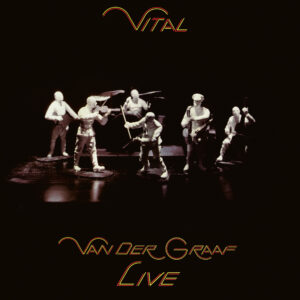
Adding Charles Dickie on cello, electric piano and synthesiser after the album’s release, they went on tour, climaxing with two nights at the Marquee Club on 15th – 16th January 1978. That event saw the guest reappearance of David Jackson on saxophone and flute, who’d also performed on two tracks of the studio album. It resulted in the double album, Vital – Van Der Graaf Live, and for some the static noise as the needle went down on their vinyl turntable was music to their ears because the aural onslaught that followed was at times akin to an armoured tank making mincemeat of Attila the Hun and all his marauding hordes.
It made musique concrète passé, with shrieking amped-up symphonic instruments and a distorted bass tearing off into madcap rages while a synthesiser would bleat out random sequences; any hope that the post-punk movement could position itself as something defiantly original relied on the propaganda of the London-centric music rags of the times.
It featured but one track from the studio album they were touring, ‘Last Frame’. Albeit, apparently, the set started with ‘Cat’s Eye/Yellow Fever’ and ‘The Sphinx In The Face’; their continued omission on this latest edition, taken from the original master tapes, suggests it failed to record, or the sound quality too poor for even being included as bonus tracks. Either way, by the time Vital was released the band had gone their separate ways a month previous. Their mission accomplished.
Vital was a hard album to love first time round. Partly, that may have been the background hiss of my vinyl edition, and Potter’s bass likely proved too hard a task master for the stereo’s speakers. More so, these former university bods weren’t messing about; this was brutal, an assault to the senses, and we’re talking someone who didn’t get round to buying it until a decade or more after it had been released. So, here’s a loud cheer for technology, where the crackles and pops heard are now the intended striking of Evans jazz shuffling drum kit or Dickie holding down a specific note electronically.
Mastered from the original tapes, with fully restored artwork and a new essay with band interviews. Completists need this. It’s Van Der Graaf but not as we know it, Jim.
Place disc one, side one on your record player and stand back. ‘Ship of Fools’ is a nihilistic boot stomp. Potter’s bass alone comes on like the whole of The MC5 lobbing hand grenades, while the band collectively make the combined members of the Velvet Underground and King Crimson sound like kittens in need of fresh milk compared to what’s going on down here. The venom-spat lyrics conjure disparate disturbing yet fascinating images, go listen.
If ‘Still Life’ is Van Der Graaf’s torch song to death, Smith’s violin sits like a devil on Hammill’s shoulder, taunting, advising, or sympathising with the delivery of every poignant line. Dickie’s deep cello joins, preparing the way for three and half minutes as they kick in collectively, the shift more profound than the studio version and more akin to The Stranglers. Smith’s violin continues to cut deep with ravaged emotion, his first bowing of the strings across this hardier section will stop you in your tracks, like some damsel screaming in some vintage Hammer movie before dancing wildly within the framework. The piece goes through another couple of sections, all dramatic, climaxing like the ultimate operatic tragedy. Hammill’s passively understated “Thank you” as the crowd applauds, as profound in its own way as James Brown faking refusal to leave the stage.
The nine minute long ‘Last Frame’ proves somewhat gentler, more melodic, a chance to get a stiff drink, even as the hardier sections preside. More traditionally prog rock in places, vaguely science fiction orientated as the lyrics ponder time and space, through memory viewing a photo of a former lover, or presumably. ‘Mirror Images’ reflects that in theme at least. Somewhat courtly in an Elizabethan renaissance manner and again with familiar progressive rock tropes in evidence, Jackson appears on stage, his wind instruments playing alongside Smith’s violin. Next, Hammill heads towards the piano and there is a major tonal shift, as they play a greatest hits section under the collective title ‘Medley: A Plague of Lighthouse Keepers /The Sleepwalkers’ – At just under 14 minutes, it’s almost an audiobook with accompanying music. Where decades back this section didn’t work for me, as technology and media in general have changed this now feels much more, right, and the jazz section during ‘The Sleepwalkers’ is simply cool.
Disc two, or side three on vinyl offers ‘Pioneers Over C’, as an almost bluesy riff oscillates into something wilder, dystopian, thrash jazz like at times, and much less distorted than its original vinyl rendition with each instrument clearly heard. But this is simply its first section. At just over 17 minutes long it goes through many moods, assorted instruments taking lead position, and even as you think one might be jostling to take precedence they spin collectively and the music changes yet again, soft, hard, fast, slow, not always easy to take, but live without a net. ‘Sci-Finance’ is shimmering psychedelic early Lou Reed seen through a peculiar Brideshead Revisited lens, at least for the first minute or so, turning into a Guy Richie mobster adaptation of a John Le Carre novel as Hammill growls “Show me the money!” as the band pummel down hard and heavy. A comment on management thriftiness of the time, a likely scenario, considering the band subsequently folding.
‘Door’ I’d previously tended to find somewhat impenetrable, with no pun intended. Hammill gives a lengthy explanation to the song’s concerns, but to me it was more like a poor man’s ‘Ship of Fools’. This remastered version strikes a blow for re-evaluation, clearer sounds offer truly bonkers instrumentation that this old fool now adores. The ‘Urban’Killer/Urban’ mash-up that follows again opens with an oddball blues feel, Evans drumming taking that into jazzier directions, then not quite sure if it wants to rock or become pop ditty, it grunts and shuffles as reluctant combination with extended prog melodies in between. Do not listen to while on drugs.
It all ends with ‘Nadir’s Big Chance’, the title track from Hammill’s 1975 solo album, and British punk’s touchstone; not only for its influence on John Lydon, but its glam rock fashion lyrical affectations being just the sort of thing Malcolm McLaren and Vivienne Westwood were putting up for sale in their Chelsea boutique shop. The shortest song on the collection, it thunders along, spewing venom gloriously, ending Vital as catharsis to any and all-such pent-up aggressions.
Reappraising Vital, it’s still an album that could polarise opinions. Those on stage play not with arrogance but brutal indifference to anything but the music itself; inventing and inverting with equal force, often pluck victory from where you’d sense defeat. If only it had been filmed, what a sight those gathered at the old Marquee must have witnessed.
- Reviewed by Paul H Birch.
- Vital: Van Der Graaf Live is released via Cherry Red Records on 29th March 2024.
Track List:
CD 1:
- Ship of Fools
- Still Life
- Last Frame
- Mirror Images
- Medley: A Plague of Lighthouse Keepers /The Sleepwalkers
CD 2:
- Pioneers Over C
- Sci-Finance
- Door
- Urban / Killer / Urban
- Nadir’s Big Chance

